Silky Zubat
Silky Zubat
Couldn't load pickup availability
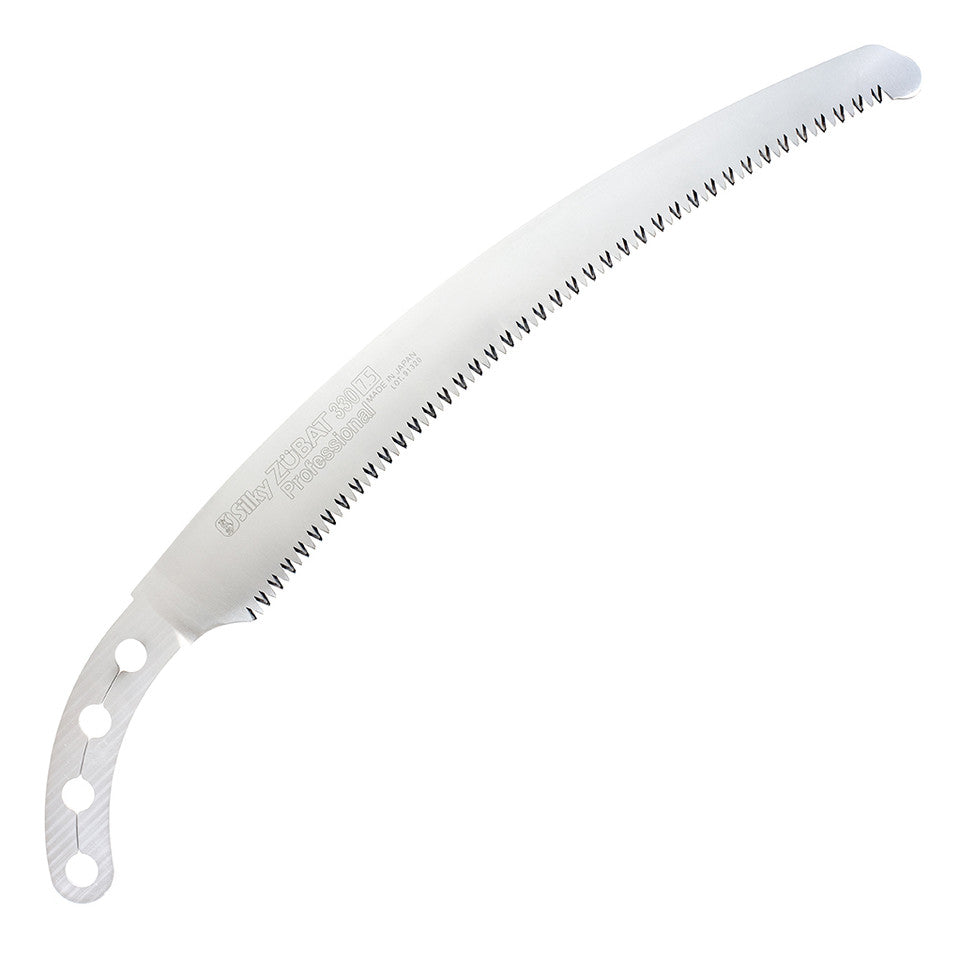
This is what we keep in the pruning kit for the jobs that are too big for our Silky Pocketboys and Gomboys. It's a professional, heavy-duty arborist's saw suitable for larger cuts.
The Zubat has a curved blade for faster cutting speed with less effort and a molded rubber handle for a firm, easy grip. Apparently Zubat, or Zubatto in Japanese, refers to the sound of something that is hit directly on target.
Unlike western saws that cut on the push stroke, Japanese saws cut on the pull so there's less chance of the blade jumping, making for a cleaner, finer cut with a lot less effort.
Zubat blades cannot be re-sharpened due to the use of electro-impulse hardening in the manufacturing process. Replacement blades are available.
Product Details
Product Details
Caring for your Saw
Caring for your Saw
Correct Use of your Japanese Saw:
- Cut on the pull stroke, glide back on the push stroke. Cutting when pulling uses less energy, gives the user more control, and results in a straighter cut.
- Use a smooth, gentle sawing action, its not about applying maximum force or how strong you are.
- Do not twist or bend the blade while sawing and ensure the weight of the branch does not pinch or catch the blade - or you may snap the end off the blade.*
- Use the right length of blade for the job: general rule of thumb is to cut branches with a diameter equal to no more than 1/3 the length of the blade.*
*Blades that snap through incorrect use are not covered under warranty. Replacement blades are available as an option on each saw product on our website. Replacement screws are also available, please contact us for details

Caring for your Japanese Saw:
- Clean and dry saw blades after every use.
- Saw blades are made of rust-resistant steel but they may stain or discolour through regular use. An abrasive block should clean up most discolouration and a drop or two of camellia oil to the screw will keep everything loose.
- Impulse-hardened blades (most Silky and ARS Saws) should not be sharpened. The hardening process creates a very sharp blade that lasts 3 times as long as a conventional blade but it is very hard to sharpen without removing the extra hardness from the steel. For that reason, full-grind sharpening is not recommended; if you must, just do a light touch-up by hand. Replacement blades are available once the blades are really dull.
- Non-impulse-hardened saw blades can be sharpened with a file.
Cleaning & Sharpening your Japanese Pruning Tools
Cleaning & Sharpening your Japanese Pruning Tools
Click here to download The Gardener's Kit Guide to Cleaning & Sharpening your Japanese Pruning Tools
We recommend that you clean, sharpen, oil - in that order and be sure to sharpen before the blades get blunt.
How Often?
It's a common question - how often should I sharpen my cutting tools? Short answer is, it depends on how frequently you use your tools.
Here are recommendations based on frequent use; you can judge from there if you don't use your tools often.
- Secateurs: every couple of weeks if you use them daily. Click here to watch the experts at Okatsune sharpen secateurs.
- Shears: daily, or even throughout the day, when you’re using them intensively. Especially if clipping boxwood. Click here to watch Jake demonstrate how to sharpen the Niwaki shears
- Saws: clean and dry saws after every use. Impulse hardened blades do not need to be sharpened. Click here for our Guide to Saw Care
How To?
- Wipe off soil and mud (you should get in the habit of doing this and then drying your tools at the end of each workday).
- Clean built-up gunk and rust off the blades with the Abrasive Cleaning Block or Crean Mate rust eraser.
- Do a detailed sharpening with a whetstone or two - see below for 'Which Grit' to use. Soak your sharpening stone in water for a couple of minutes before using. Unless you are very handy, don’t take your secateurs and shears apart – it’s very difficult to get the double-locking bolt back together and the blades properly aligned.
- You can sharpen on-the-go with the Swiss Istor carbon steel sharpener, but a light touch is required - you don't want to grind off too much steel.
- Use the Twin Diamond File or the Niwaki grey #220 grit sharpening stone to restore damaged blades.
- Apply Camellia Oil to lubricate and protect blades after cleaning. You're done!
If you don’t like sharpening yourself, or don’t have time for it, use our in-house sharpening service.
Which Grit?
The appropriate whetstone grit depends on the type of steel, how long it's been between sharpening sessions, and whether there’s been any significant damage to the blades.
We recommend using the manufacturer's recommendation for the tools that we sell.
- Okatsune #400 grit - for regular sharpening of all Okatsune products; also good for Felco
- Niwaki #220 grit (grey) - this is a coarse stone, use for rough/damaged blades
- Niwaki #1000 grit (brown) - for regular sharpening of all Niwaki, Tobisho, Kurumi blades.
- Niwaki #3000 grit (sand) - this is a fine polishing stone, use for detailed work on high quality steel
Click here for the full collection of Japanese Tool Care products
CANADA Shipping + Local Pick-up
CANADA Shipping + Local Pick-up
Local Pick-Up
Is available from our Vic West Showroom, in Victoria BC.
Directions & store hours can be found HERE
Flat Rate Shipping CANADA
Small Items
- within BC $15
- Canada $20
Medium Items
- within BC $20
- Canada $25
Large Items $30
- within BC $30
- Canada $40
Extra Large Items $60
- within BC $60
- Canada $75
SEE FULL SHIPPING DETAILS, CLICK HERE
USA SHIPPING IS FINAL SALE
USA Shipping FINAL SALE
USA Shipping FINAL SALE
Shipping to the USA
We’re happy to resume shipping to our USA customers from our warehouse in Victoria, BC, Canada.
Please note: Prices at checkout are shown in USD and do not include any applicable import duties, tariffs, taxes, or brokerage fees. These charges are the responsibility of the customer and will be collected by the courier upon delivery.
ALL USA ORDERS ARE FINAL SALE and are not eligible for returns or exchanges. This includes cancelled orders and refused shipments.
Please review your order carefully before completing your purchase.