Okatsune Flower Snips
Okatsune Flower Snips
Couldn't load pickup availability
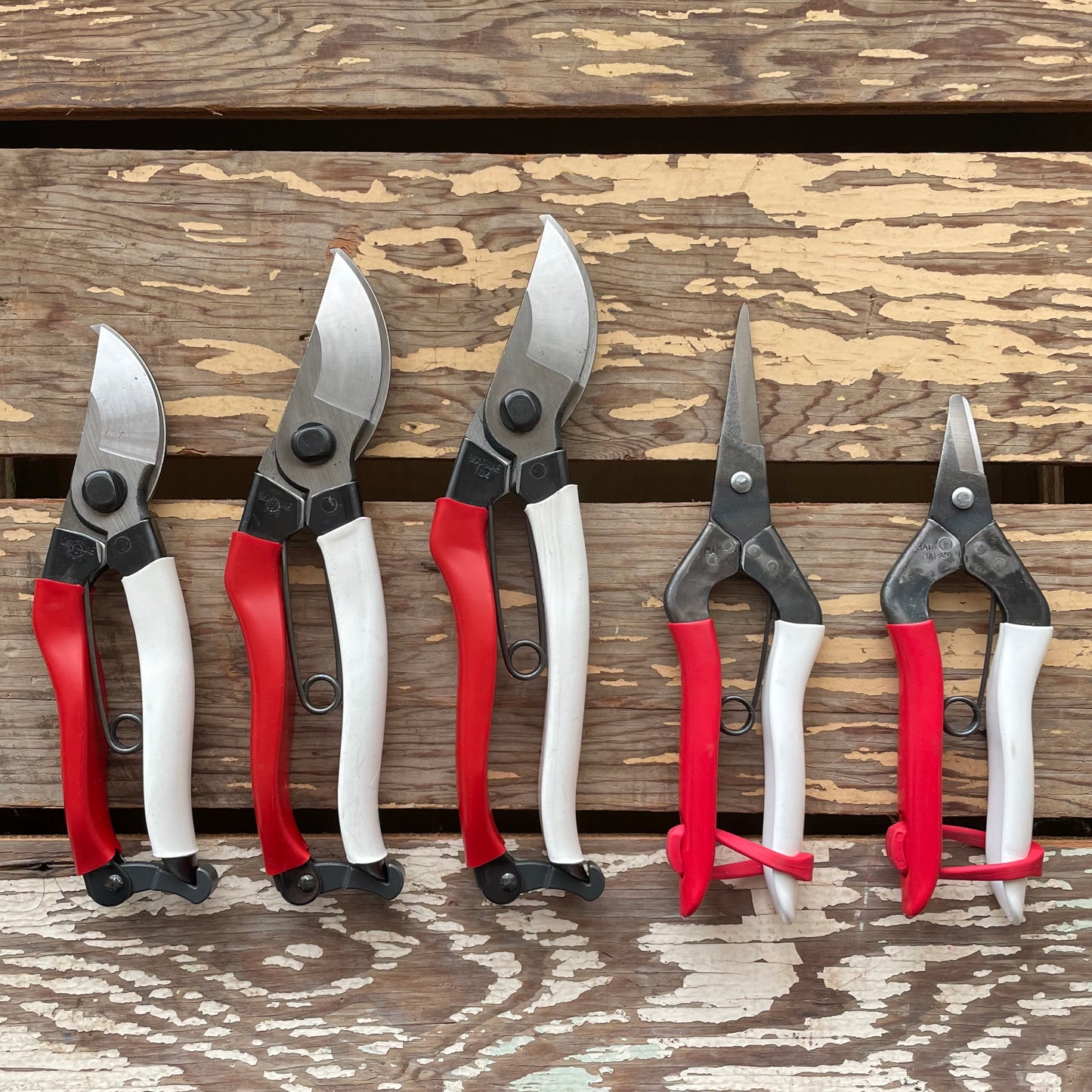
Snips are smaller, lighter and less bulky than secateurs and are designed to be used on soft, green growth, nothing woody. I like to use them for deadheading, cutting flowers, harvesting veggies, and cutting lengths of twine for staking. The long skinny blades allow you to get into tight spaces and make precise cuts. Super handy!
Their smaller size and rounded tips allow you to carry them in your pocket without doing damage, but I like to carry them in my pouch so I always know where they are. They also fit perfectly in a single holster, and I sometimes snug them into my double holster with my hori hori.
All Okatsune snips come with a spare spring, although I haven’t needed mine yet and I’ve been using my snips for several years.

Product Details
Product Details
Caring for Snips, Shears & Clippers
Caring for Snips, Shears & Clippers
Similar to how to care for your secateurs, the key to a long life for your shears is to be sure to maintain them well through regular cleaning & sharpening. As well as ensuring you use them the way there intended to be used.
Correct use of your Snips, Shears & Clippers:
- Keep them sharp & oiled, sharpen after every use
- Japanese steel is hard and sharp, and can be more brittle than people are used to - it will chip if abused.
- Do not cut wire, metal, stone, plastic or any other hard material (even bamboo fibres and some very hard woods, especially knots and burrs, can damage steel edges).
- Do not twist or apply uneven pressure.
- Shears and clippers are to be used on fine green growth only, no woody stems.
- Cut diagonally across branches, not horizontally or straight across.
- Watch out for maximum cut lengths, shears are not loppers or secateurs.
- Use the base of the blades, not the tips, for heavier cuts.
Cleaning & Sharpening:
The first rule of thumb is to keep them clean & sharp... Shears, in particular, like to be sharpened with every use.
Click here for a detailed guide on how to clean and sharpen your Japanese pruning tools.
Cleaning & Sharpening your Japanese Pruning Tools
Cleaning & Sharpening your Japanese Pruning Tools
Click here to download The Gardener's Kit Guide to Cleaning & Sharpening your Japanese Pruning Tools
We recommend that you clean, sharpen, oil - in that order and be sure to sharpen before the blades get blunt.
How Often?
It's a common question - how often should I sharpen my cutting tools? Short answer is, it depends on how frequently you use your tools.
Here are recommendations based on frequent use; you can judge from there if you don't use your tools often.
- Secateurs: every couple of weeks if you use them daily. Click here to watch the experts at Okatsune sharpen secateurs.
- Shears: daily, or even throughout the day, when you’re using them intensively. Especially if clipping boxwood. Click here to watch Jake demonstrate how to sharpen the Niwaki shears
- Saws: clean and dry saws after every use. Impulse hardened blades do not need to be sharpened. Click here for our Guide to Saw Care
How To?
- Wipe off soil and mud (you should get in the habit of doing this and then drying your tools at the end of each workday).
- Clean built-up gunk and rust off the blades with the Abrasive Cleaning Block or Crean Mate rust eraser.
- Do a detailed sharpening with a whetstone or two - see below for 'Which Grit' to use. Soak your sharpening stone in water for a couple of minutes before using. Unless you are very handy, don’t take your secateurs and shears apart – it’s very difficult to get the double-locking bolt back together and the blades properly aligned.
- You can sharpen on-the-go with the Swiss Istor carbon steel sharpener, but a light touch is required - you don't want to grind off too much steel.
- Use the Twin Diamond File or the Niwaki grey #220 grit sharpening stone to restore damaged blades.
- Apply Camellia Oil to lubricate and protect blades after cleaning. You're done!
If you don’t like sharpening yourself, or don’t have time for it, use our in-house sharpening service.
Which Grit?
The appropriate whetstone grit depends on the type of steel, how long it's been between sharpening sessions, and whether there’s been any significant damage to the blades.
We recommend using the manufacturer's recommendation for the tools that we sell.
- Okatsune #400 grit - for regular sharpening of all Okatsune products; also good for Felco
- Niwaki #220 grit (grey) - this is a coarse stone, use for rough/damaged blades
- Niwaki #1000 grit (brown) - for regular sharpening of all Niwaki, Tobisho, Kurumi blades.
- Niwaki #3000 grit (sand) - this is a fine polishing stone, use for detailed work on high quality steel
Click here for the full collection of Japanese Tool Care products
About Okatsune Tools
About Okatsune Tools
CANADA Shipping + Local Pick-up
CANADA Shipping + Local Pick-up
Local Pick-Up
Is available from our Vic West Showroom, in Victoria BC.
Directions & store hours can be found HERE
Flat Rate Shipping CANADA
Small Items
- within BC $15
- Canada $20
Medium Items
- within BC $20
- Canada $25
Large Items $30
- within BC $30
- Canada $40
Extra Large Items $60
- within BC $60
- Canada $75
SEE FULL SHIPPING DETAILS, CLICK HERE
USA SHIPPING IS FINAL SALE
USA Shipping FINAL SALE
USA Shipping FINAL SALE
Shipping to the USA
We’re happy to resume shipping to our USA customers from our warehouse in Victoria, BC, Canada.
Please note: Prices at checkout are shown in USD and do not include any applicable import duties, tariffs, taxes, or brokerage fees. These charges are the responsibility of the customer and will be collected by the courier upon delivery.
ALL USA ORDERS ARE FINAL SALE and are not eligible for returns or exchanges. This includes cancelled orders and refused shipments.
Please review your order carefully before completing your purchase.